
Concrete Steps & Stairs
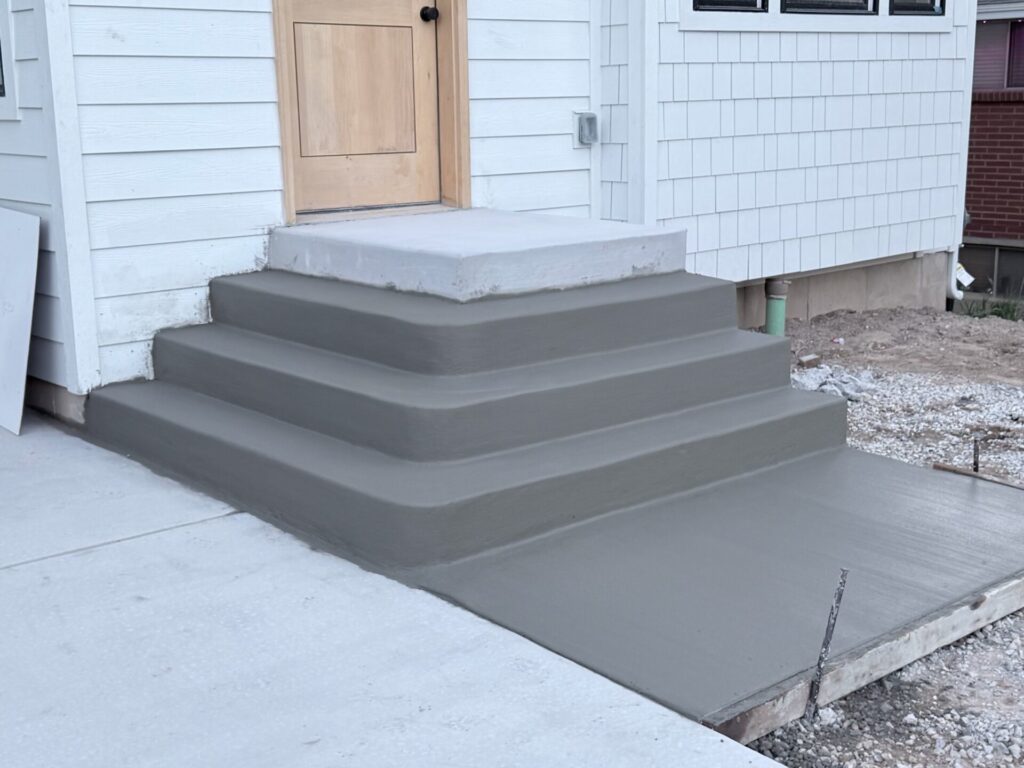
Concrete Steps & Stairs in Provo & Utah County, UT
Poured concrete steps are one of the highest-traffic, most safety-critical elements of any home. Bedrock Concrete Pros designs and builds front stoops, porch steps, and exterior stairways that are code-compliant, slip-resistant, and built to hold up through Utah’s freeze-thaw winters — backed by our workmanship warranty.
Concrete steps seem straightforward, but a surprising number of Utah homes have front stoops or entry stairs that are crumbling, heaved, or simply unsafe. Poorly formed risers and treads, inadequate reinforcement, and bad drainage all accelerate freeze-thaw damage. When steps fail, they become a liability — a tripping hazard or fall risk for your family and guests. Bedrock Concrete Pros builds steps right from the start: proper rise-and-run dimensions, steel reinforcement, well-compacted base, and a slip-resistant finish your family can rely on year-round.
Concrete Steps & Stair Services We Provide
Whether you need a new set of porch steps, a full exterior stairway, or a replacement for crumbling entry stairs, we handle it all:
- Front stoop & entry steps — new poured concrete steps that match your home’s grade, door height, and style.
- Porch steps — single or multi-flight steps connecting a covered porch to the yard or driveway.
- Exterior stairways — multi-step stairways from grade changes, retaining walls, or raised entries.
- Step replacement — demolition and pour of failing, cracked, or heaved concrete steps.
- Step repair & patching — when the structure is sound but edges, faces, or treads are spalling or chipping.
- Landing pads — properly sized concrete landings at the top or bottom of a stair run.
- Handrail anchor pockets — formed anchors set in the pour for post-installed iron or steel rails.
Rise, Run, and Code: Why Dimensions Matter
Utah residential building code follows the IRC standard: risers should be between 4 and 7¾ inches tall, and treads (the horizontal surface you step on) must be at least 10 inches deep. Consistent rise-and-run throughout a flight is just as important as the individual measurements — even a quarter-inch variation between steps is enough to cause a stumble. We form every step to uniform, code-compliant dimensions and confirm measurements before the pour. We also size landings correctly: at least as wide as the stair and a minimum of 36 inches in the direction of travel.
If your project is subject to a building permit — which is common for large entry stairways or anything tied to new construction — we work within those permit requirements. Ask us during your free estimate.
Built for Utah’s Freeze-Thaw Conditions
Steps take more abuse from freeze-thaw than almost any other concrete surface. They face north or east exposures, catch snowmelt from the roof, and collect water in the tread-to-riser joint — all of which drive rapid deterioration if the concrete and drainage aren’t done right. Here is how we build steps to last in Utah County and across the Wasatch Front:
- Air-entrained 4,000 PSI concrete — the microscopic air voids absorb the expansion stress of freezing water, dramatically reducing surface spalling.
- Compacted granular base — we remove unstable soil and compact road base beneath the steps so the structure won’t settle or heave.
- Steel rebar reinforcement — rebar ties the steps together and prevents cracks from propagating through the structure.
- Proper drainage slope — treads are formed with a slight forward pitch (typically ¼” per foot) so water sheds forward instead of pooling and penetrating.
- Sealed after cure — we recommend sealing steps every 2–3 years and avoiding de-icing salts, especially the first winter after a new pour.
Utah’s expansive clay soils add another challenge: soil that swells with moisture and shrinks in dry summers can lift and crack improperly founded steps. Our base prep accounts for local soil conditions, so your steps stay level over time. Learn more about how we handle freeze-thaw at our concrete repair and resurfacing page.
Slip Resistance, Finishes & Options
A smooth concrete tread is a slip hazard when wet or icy. We always finish treads with a texture that gives safe footing through rain, snow, and ice. Popular finish options include:
- Broom finish — the standard slip-resistant finish; light or heavy brooming controls the texture level.
- Salt finish — rock salt pressed into the surface then washed out leaves a pitted, grippy texture with a decorative look.
- Exposed aggregate — pebbles or crushed stone at the surface add traction and visual interest.
- Stamped riser faces — decorative patterns on the vertical riser face for a custom look while keeping treads slip-resistant.
- Color integral or stain — earth tones and custom colors that complement the home’s exterior masonry or concrete foundation.
- Anti-slip additive in sealer — for already-smooth surfaces, a sealer with grit aggregate significantly improves wet traction.
If your steps are part of a larger outdoor project — a new patio, a driveway apron, or a walkway leading to the entry — we can coordinate finishes so everything ties together.
Repair vs. Replace: Making the Right Call
Not every damaged set of steps needs full demolition. Here is a practical guide to help you think it through before we arrive for your free estimate:
Repair makes sense when:
- Damage is limited to surface spalling or chipping on one or two treads
- Edges are breaking off but the interior structure is solid
- Cracks are surface-level (not full-depth or structural)
- The steps are relatively level and haven’t shifted significantly
Replace when:
- Steps have heaved, settled, or tilted (drainage / footing failure)
- Full-depth cracking or separation between steps
- The base has eroded — hollow sound when you tap the tread
- Repair cost approaches or exceeds replacement cost
We will give you an honest assessment at your free on-site estimate. If repair is genuinely the better value, we’ll say so. For larger structural repairs, see our concrete repair and resurfacing services.
How Much Do Concrete Steps Cost in Utah?
Step pricing varies more than most flatwork because every job has a different number of steps, landing size, site complexity, and finish. Here are typical estimates for Utah County projects:
These are rough estimates for budgeting only. Actual pricing depends on the number of steps, landing area, site access, demolition needs, soil conditions, and finish selected. Request a free on-site estimate for an exact quote.
Our Concrete Steps Installation Process
From your first call to the day your new steps are ready to use, here is what to expect:
Free On-Site Estimate
We visit your property, assess the existing steps or site, measure the grade change, and discuss your finish options. You get a clear written quote with no obligation.
Demo, Excavation & Base Prep
We remove any old steps and haul the debris off-site. We then excavate to stable soil, add and compact a granular road-base sub-base, and form the step structure with steel-reinforced framing.
Pour, Finish & Form Removal
We place air-entrained 4,000 PSI concrete, finish the treads to your chosen slip-resistant texture, and install any decorative elements on riser faces. Forms come off typically within 24–48 hours.
Cure, Cut & Walkthrough
We let the steps cure properly before you use them — typically 24–48 hours before light foot traffic. We walk the finished job with you and advise on sealing timing and first-winter care.
Why Choose Bedrock Concrete Pros for Your Steps
Concrete steps are a small part of the house that carries a big safety responsibility. Cutting corners on reinforcement, base prep, or rise-and-run consistency is how people get hurt. We take that seriously.
- Licensed & insured — Utah Lic. #14282236-5501
- Free, no-pressure written estimates
- Code-aware rise/run dimensions on every pour
- Air-entrained 4,000 PSI concrete — Utah freeze-thaw ready
- Steel rebar reinforcement and compacted base as standard
- Slip-resistant tread finishes on every job
- Workmanship warranty backing every project
- Honest repair-vs-replace assessment — no upselling
We serve homeowners in Provo, Orem, Lehi, American Fork, Pleasant Grove, Springville, Draper, Sandy, and throughout Utah County and the Wasatch Front.
If your project also involves a new entry walkway, patio, or we’re working alongside a foundation pour, we can coordinate all the concrete work in a single project visit. See our related services: concrete repair & resurfacing, concrete foundations, sidewalks & walkways, and patios.
Concrete Steps & Stairs — Frequently Asked Questions
How long do poured concrete steps last in Utah?
Properly installed concrete steps — with rebar reinforcement, a compacted base, the right mix, and routine sealing — can last 30 to 50 years in Utah’s climate. The biggest enemies are freeze-thaw cycles, de-icing salts, and water that pools in the tread-to-riser joint. Sealing every 2–3 years and skipping salt (use sand or kitty litter for traction) extends life significantly.
Do I need a permit for new concrete steps in Utah?
It depends on the scope and your municipality. Minor repairs and replacement of existing steps often don’t require a permit. New construction, steps over a certain height, or steps attached to a structure often do. We’ll let you know at the estimate what’s typical in your city. You’re always responsible for pulling any required permits, though we can advise on what’s needed.
Can you repair just a few crumbling edges on my steps?
Often yes. Edge spalling and chipping on an otherwise structurally sound step can be repaired with a bonded concrete overlay or hydraulic cement patching. The key is whether the substrate is still solid — if the interior concrete is sound, a quality repair holds well. We’ll check for hollow spots and deep cracking at your estimate before recommending repair vs. replacement.
How soon can I walk on new concrete steps?
You can typically use your new steps for light foot traffic after about 24–48 hours. Full curing takes 28 days, and the concrete continues to gain strength during that window. We’ll give you specific timing guidance based on weather conditions at the time of your pour.
What is the correct rise and run for concrete steps?
Utah follows IRC standards: risers (the vertical face) should be 4 to 7¾ inches, and treads (the horizontal surface) must be at least 10 inches deep. Consistency matters as much as the numbers — every step in a flight should be the same height. We measure and form to code-compliant, uniform dimensions every time.
Do you pour steps in winter?
Yes, with proper precautions. Cold-weather concrete work requires blankets, accelerators, and careful timing around temperature drops. There are some days when pouring is not practical — if the forecast calls for extreme cold immediately after a pour, we’ll discuss waiting for a better window. We’re honest about timing because a properly cured pour is always better than a rushed one.
Request Your Free Quote
Tell us about your project and we’ll get back to you fast. Prefer to talk? Call (801) 854-7174.
Ready for Safe, Durable Concrete Steps?
Get a free, written estimate for your concrete steps project anywhere in Utah County or the Wasatch Front. No pressure, no obligation.