Pickleball Courts · Utah Cost Guide
How Much Does a Pickleball Court Cost in Utah?
A backyard pickleball court is one of the most popular upgrades Utah homeowners are making right now. Costs range from about $25,000 for a basic concrete slab with acrylic surfacing to $80,000 or more for a cushioned, lit, fenced premium court. Here’s a plain-English breakdown of every cost factor so you can plan your budget.
Pickleball Court Cost at a Glance
Before diving into the details, here are typical installed price ranges for a single-court build in Utah. All figures are estimates; your actual cost depends on site conditions, finish choices, and local material and labor prices at the time you build.
All ranges are Utah estimates for planning purposes only. Site prep, grading, soil conditions, and finish choices significantly affect final cost. Contact us for a free, written estimate specific to your property.
The Concrete Base: The Foundation of Every Good Court
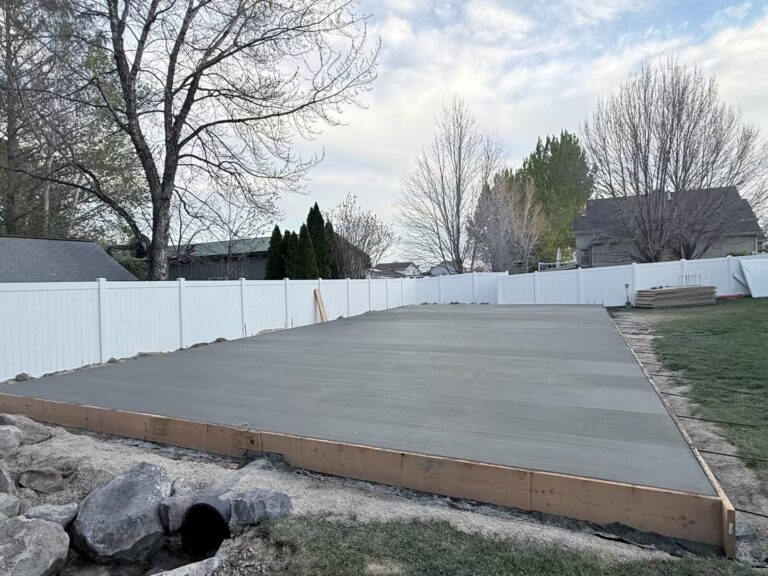
The biggest variable in pickleball court cost is almost always the concrete slab — and it’s where corners get cut most often. A regulation pickleball court is 20′×44′ (the actual playing surface), but you need buffer space around every line. A standard residential build uses a 30′×60′ concrete slab, giving players room to run down balls and place equipment.
For sport courts in Utah, we specify:
- 4-inch slab thickness — minimum for a sport court surface that won’t crack under foot traffic and equipment.
- 3,000+ PSI concrete mix — strong enough to support repeated impact and resist Utah freeze-thaw cycles. Many sport court contractors specify 3,500–4,000 PSI for longevity.
- #4 rebar on a 16″ grid — rebar (not just wire mesh) keeps the slab together through temperature-driven expansion and contraction.
- Compacted road-base sub-base — 4–6 inches of compacted gravel under the slab prevents settling and cracking from unstable soil below.
- Proper slope for drainage — 1% cross-slope (about 1/8″ per foot) sheds water without affecting play.
- Control joints — placed to guide any shrinkage cracking to predictable, manageable locations.
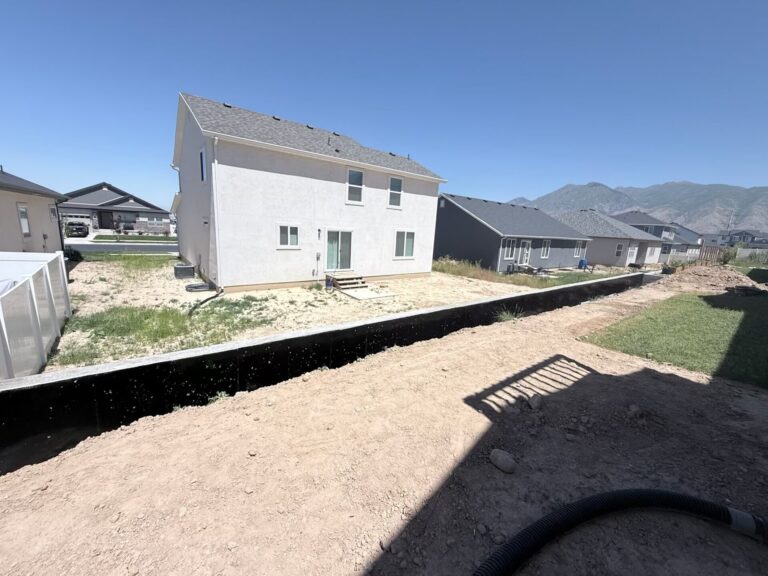
Why does this matter for Utah specifically? The Wasatch Front sits on expansive clay soils in many areas — particularly in parts of Utah County and the south Salt Lake Valley. Those soils swell when wet and shrink when dry, which means a slab poured directly on unprepared ground can heave, settle unevenly, and crack within a few seasons. Proper excavation and base prep adds cost upfront but prevents expensive repairs later.
Our pickleball court concrete service covers the full slab: grading, excavation, base compaction, forming, rebar placement, pour, finish, and control-joint cutting. The concrete base typically runs $8,000–$15,000 for a 30′×60′ slab in Utah County, depending on site conditions and how much grading is needed.
Surfacing Options: Acrylic vs. Cushioned Systems
The surface coating is the second major cost driver and has a real impact on how the court plays and how your joints feel after a long game. There are two main options for residential courts:
Acrylic Court Surfacing
Standard acrylic surfacing is the most common choice for backyard courts. It’s applied in multiple coats directly over cured concrete, creating a slightly textured surface that provides good traction, true ball bounce, and clear line visibility. Acrylic surfaces are durable, easy to maintain, and available in a range of colors — the USAPA-standard court is typically dark blue/green with a lighter color inside the kitchen (non-volley zone).
Cost for acrylic surfacing and striping on a 30′×60′ court typically runs $5,000–$12,000, depending on the number of coats and the coating quality. Budget systems use 2–3 coats; higher-quality installs use 4–6 coats for better color retention and longevity.
Cushioned Court Systems
Cushioned surfaces add a rubberized underlayment layer (or multiple layers of progressively softer acrylic) between the concrete and the finished playing surface. The result is noticeably easier on knees, ankles, and hips — a meaningful benefit if you’re playing daily or dealing with joint issues. Cushioned systems add $7,000–$15,000 over standard acrylic but are standard on any USAPA-sanctioned tournament court and are increasingly popular for high-end residential builds.
The cushion level is measured in millimeters of underlayment. Common residential choices range from a light 1–2 mm cushion (barely noticeable, mostly for crack-fill/leveling) up to a full 5–8 mm sport-cushion system that significantly reduces joint impact.
Bottom line: if budget is a priority, acrylic is a great choice and will produce a playable, attractive court. If you play frequently or have joint concerns, the cushioned upgrade is worth the investment.
Striping, Nets, and Other Equipment Costs
Court striping is typically included in the surfacing cost, but net systems are a separate line item. Here’s what to budget for the non-slab, non-surface components:
- Court striping — usually included with surfacing. Lines are applied with the acrylic topcoat for clean, permanent markings.
- Net posts & sleeves — galvanized steel posts set in concrete sleeves embedded in the slab. Budget $400–$1,200 for the hardware, plus installation labor.
- Regulation net — a USAPA-spec net (34″ at center, 36″ at posts) runs $150–$600 depending on quality. Permanent installation nets tend to be heavier-duty than portable systems.
- Fencing — a 10′-high chain-link enclosure around the court keeps balls in play and is standard on dedicated courts. Figure $4,000–$10,000 depending on the perimeter size and gate configuration.
- Windscreens — often added to fencing to reduce wind interference and improve ball visibility against busy backgrounds. Add $500–$2,000.
- LED lighting — four to six pole-mounted fixtures allow evening play, which is popular in Utah’s hot summers when daytime play is uncomfortable. Budget $3,000–$8,000 depending on the number of poles and fixture quality.
- Benches & shade structures — seating, shade canopies, and drink stations add $1,000–$5,000+ depending on complexity.
Multi-Use Courts: Pickleball + Basketball on One Slab
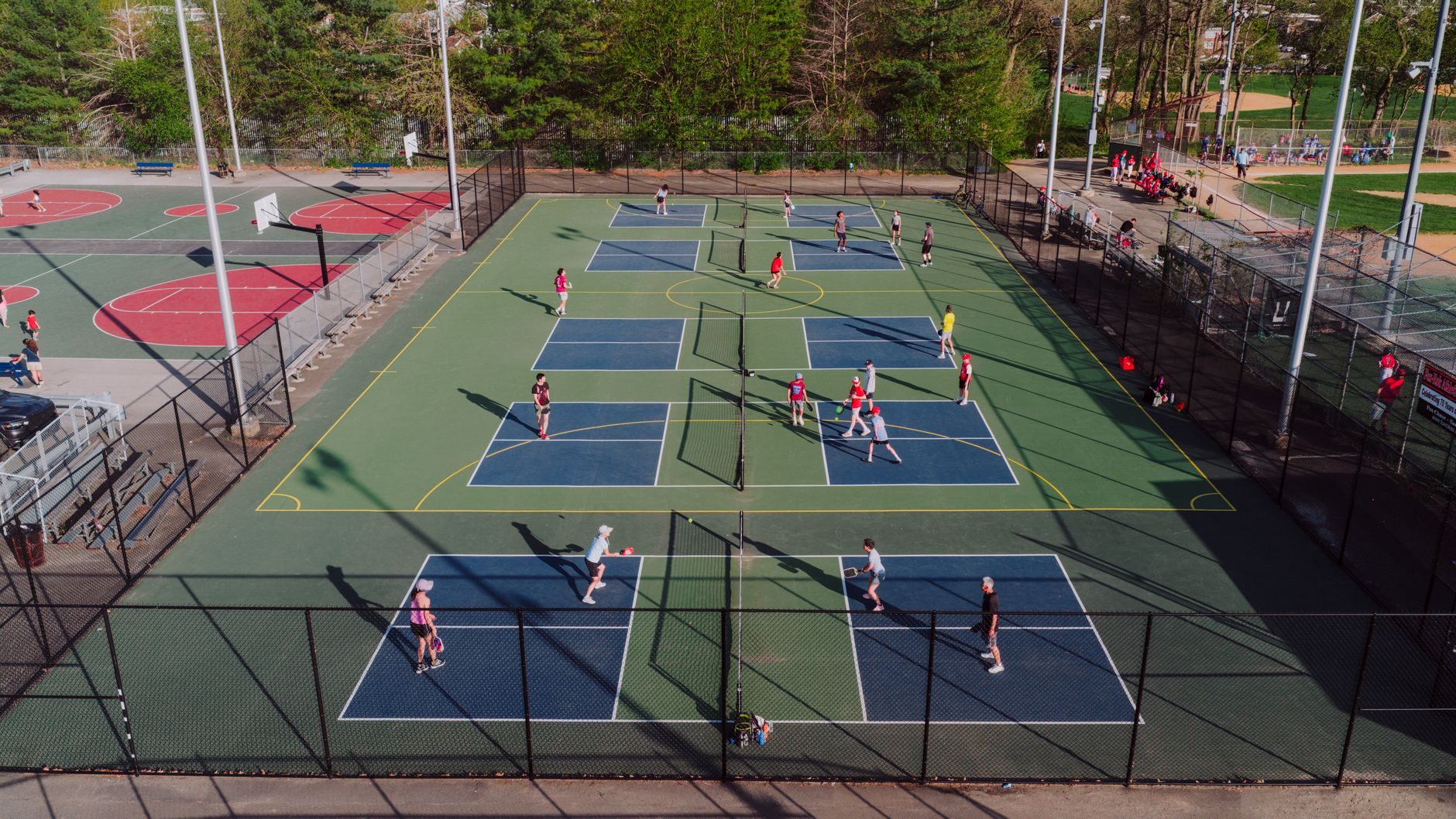
One of the smartest cost-saving moves for homeowners with families is building a multi-use sport court that accommodates both pickleball and basketball — and potentially volleyball or badminton — on a single concrete slab. A basketball half-court is typically 30′×30′ to 30′×45′, and a pickleball court fits neatly within or alongside a full basketball layout.
A 30′×60′ concrete slab is large enough to serve as a full pickleball court and a generous basketball half-court simultaneously. You add a basketball hoop system (typically $1,500–$5,000 installed for a pole-mount with backboard and hoop) and stripe both courts in different colors on the same surface. Total cost for a combo court typically runs $30,000–$65,000 depending on surfacing and add-ons.
The incremental cost to add pickleball striping to an existing basketball court — or vice versa — is modest: typically $500–$2,000 for the additional striping during the surfacing process, or $1,500–$4,000 if you resurface and re-stripe an existing slab. If you’re planning a sport court of any kind, it almost always makes sense to spec the slab for both sports from day one.
Converting an Existing Concrete Slab to a Pickleball Court
Already have a concrete patio, driveway, or old basketball court? You may be able to convert it into a pickleball court at a fraction of the cost of a new build — provided the existing concrete is in decent structural shape.
The key question is whether the existing slab is level enough and large enough. A pickleball court needs at least 30′×60′ of clear, flat concrete. If the slab is smaller, you’re looking at an addition pour. If it’s the right size, a conversion project typically involves:
- Inspection and crack repair — filling and stabilizing any existing cracks or spalls so the surfacing goes on cleanly.
- Surface grinding or skim coat — if the slab is uneven or has a rough texture, it needs leveling before acrylic coating will adhere properly.
- Acrylic surfacing + striping — same process as a new build.
- Net posts — sleeves drilled and set into the existing slab.
A slab conversion (assuming the existing concrete is in good condition) typically costs $8,000–$20,000, which is significantly less than a full new-build. If the existing concrete has major structural problems — widespread cracking, heaving, or a failing base — a full concrete repair and resurfacing assessment is the right first step. Sometimes it’s more cost-effective to remove and repour.
Not sure if your existing slab qualifies? We can take a look and give you an honest assessment during a free estimate visit. Call or text (801) 854-7174 or request a quote online.
What Goes Into a Pickleball Court Build
From first shovel to first serve — here’s how Bedrock builds a sport court slab.
Free On-Site Estimate
We walk your property, assess drainage, grade, and soil, measure the available space, and give you a clear written quote covering the concrete scope.
Grading, Excavation & Base Prep
We excavate to depth, add and compact road base, and grade for the proper 1% drainage slope — the most important step for a long-lasting slab.
Form, Reinforce & Pour
We set forms to dimension, place #4 rebar on a 16″ grid, pour 3,000+ PSI concrete, and finish it flat and smooth for the surface coating.
Cure, Cut & Hand Off
We cut control joints while the concrete is still green, let the slab cure (typically 28 days before surfacing), and coordinate with your surfacing contractor or handle surfacing ourselves.
What Affects the Total Cost Most
Two projects with identical court dimensions can have very different final prices. Here are the factors that move the needle most:
- Site grading — a flat, accessible backyard is far cheaper to work with than a sloped lot requiring significant cut-and-fill or retaining walls.
- Soil conditions — expansive clay soils common in parts of Utah County and the south Salt Lake Valley require deeper excavation and more base material.
- Access — can a concrete truck get close to the pour site? Limited access means pump trucks, which add cost.
- Surfacing system — the jump from acrylic to cushioned surfacing is $7,000–$15,000 on a single court.
- Fencing & lighting — together these two add-ons can easily add $7,000–$18,000 to the total.
- Number of courts — building two courts at once is significantly cheaper per court than building them sequentially.
If your budget is tight, the best approach is to invest in the concrete slab at full spec (don’t cut corners here — the slab is forever) and phase in surfacing upgrades, lighting, and fencing over time. A properly built bare slab with basic acrylic surfacing is a fully functional pickleball court.
Pickleball Court Cost FAQs
How much does a concrete pickleball court cost in Utah?
A full pickleball court build in Utah — concrete slab, acrylic surfacing, striping, and net system — typically costs $25,000–$40,000 for a basic setup. Add cushioned surfacing, fencing, and LED lighting and you can reach $60,000–$80,000+. The concrete base alone (30′×60′ slab at 4″ thick with #4 rebar) typically runs $8,000–$15,000.
What size concrete slab do I need for a pickleball court?
The regulation pickleball court playing area is 20′×44′, but you need out-of-bounds buffer space. The standard residential slab for a single court is 30′×60′, which gives players adequate room on all sides. For a multi-use court that also accommodates basketball, a 30′×60′ or slightly larger slab works well.
How thick should the concrete slab be for a pickleball court?
A minimum of 4 inches of concrete over a compacted road-base sub-base is standard for sport courts. We recommend specifying 3,000–4,000+ PSI concrete with #4 rebar on a 16″ grid for Utah conditions. This is heavier spec than a typical patio slab, and for good reason — a sport court needs to be flat, stable, and crack-resistant for decades.
What is the difference between acrylic and cushioned pickleball court surfaces?
Acrylic surfacing is applied directly to the concrete and provides a textured, durable playing surface with accurate ball bounce. Cushioned systems add a rubberized underlayment layer that absorbs impact and is significantly easier on joints. Acrylic is less expensive ($5,000–$12,000 for surfacing + striping); cushioned systems cost $12,000–$25,000. If you play frequently or have knee or ankle issues, the cushioned system is worth considering.
Can I convert an existing driveway or patio into a pickleball court?
Yes, if the existing concrete slab is at least 30′×60′, structurally sound, and reasonably flat. The process involves crack repair, possibly a skim coat or grinding to level the surface, then applying acrylic surfacing and striping. A conversion on good existing concrete typically costs $8,000–$20,000, much less than a full new build. We can assess your existing slab during a free estimate visit.
Do you build combo pickleball and basketball courts?
Absolutely. A 30′×60′ slab handles both a full pickleball court and a basketball half-court. We pour the slab, and surfacing contractors stripe both sports in different colors. Adding basketball striping and a pole-mount hoop system to a pickleball court build typically adds $2,000–$6,000. It’s one of the most cost-effective sport court upgrades a family can make. See our basketball court page for details.
Ready to Build Your Pickleball Court?
Bedrock Concrete Pros pours sport court slabs throughout Utah County and the Wasatch Front. Get a free, written estimate for your pickleball court concrete base — no pressure, no obligation.