Concrete Driveway Advice · Utah County
5 Signs Your Concrete Driveway Needs Replacement (Not Just Repair)
Not every cracked driveway needs to come out — but some definitely do. Here’s how to tell the difference before you spend money on repairs that won’t last, with Utah-specific guidance on what concrete failure really looks like in our climate.
Utah homeowners deal with concrete conditions that most of the country doesn’t: extreme temperature swings, dozens of freeze-thaw cycles every winter, expansive clay soils that heave and settle with moisture, and the destructive combination of de-icing salts and road chemicals. Those stresses accelerate concrete deterioration in ways that can be hard to distinguish from normal aging — until you know what to look for.
The repair-vs.-replace question comes down to one thing: is the concrete itself still structurally sound, or has the damage progressed to the point where patches and overlays are just buying a little time? This guide walks through the five clearest signs that replacement is the better investment — and what those conditions look like here in Utah County and along the Wasatch Front.
Sign 1: Widespread or Interconnected Cracking
A single isolated crack running through a slab is common and usually manageable. Concrete shrinks as it cures and control joints — the lines you see cut into the surface every few feet — are there to channel that shrinkage. When a crack forms in a control joint, that’s the slab doing exactly what it was designed to do.
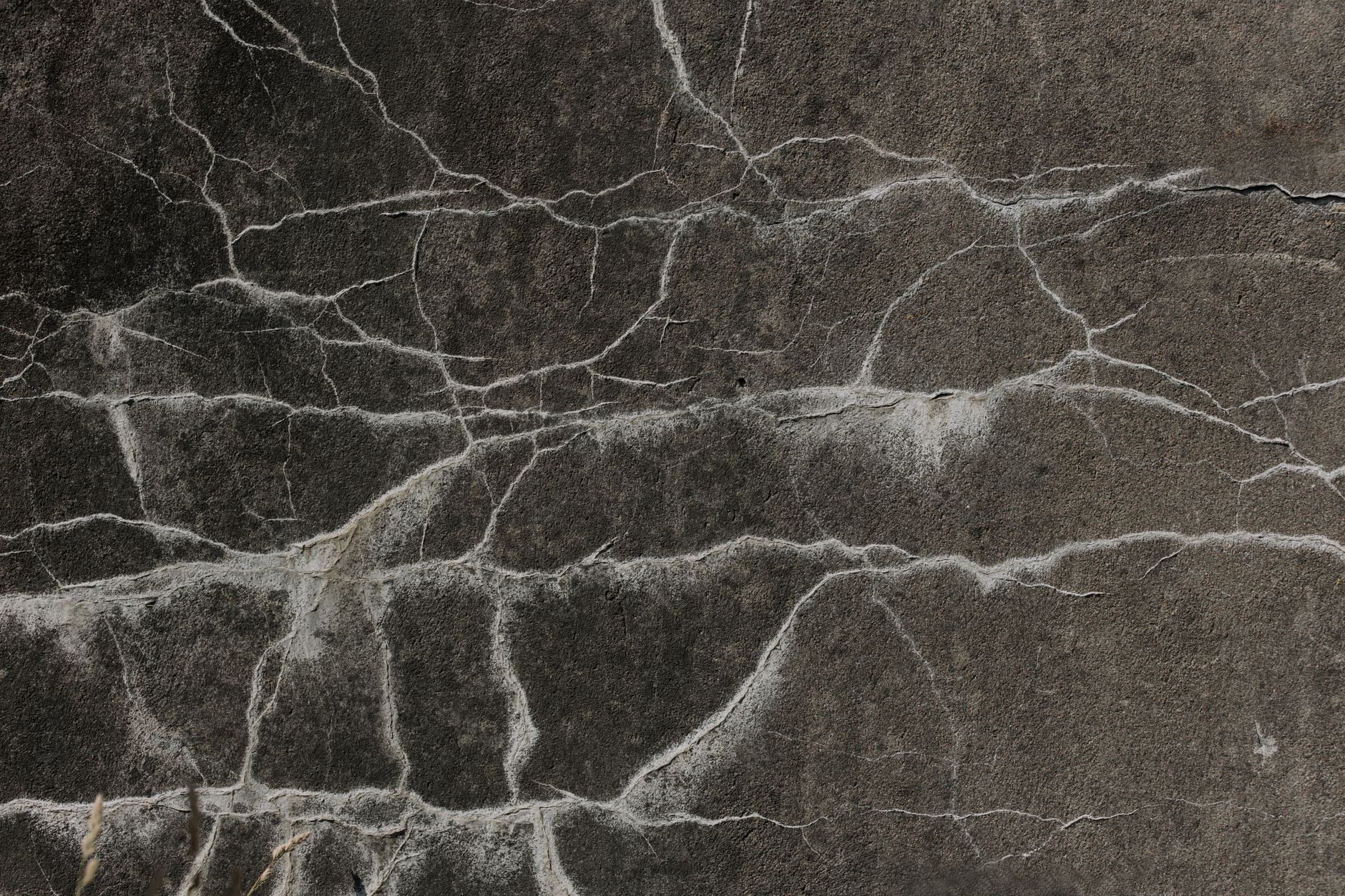
What signals trouble is when cracking is widespread, intersecting, or forming a spiderweb pattern across multiple sections. That pattern, often called map cracking or crazing, tells you the slab is breaking down structurally rather than controlling shrinkage. In Utah, this frequently develops when:
- The original concrete wasn’t air-entrained, so freeze-thaw cycles have been slowly fracturing the matrix from within
- Control joints were spaced too far apart or cut too shallow, so shrinkage cracks formed randomly across the surface
- The base shifted — often clay soil settling unevenly — and the slab flexed until it fractured
When cracks form a grid, run diagonally through corners, or appear in nearly every slab section, patching them is a losing game. Water enters every crack, freezes, expands, and widens the damage each winter. At that point, a full driveway replacement with proper base prep and an air-entrained mix gives you a clean reset that patching never will.
Sign 2: Heaving, Sinking, or Uneven Sections
When part of your driveway rides higher or lower than adjacent sections, the slab has moved — and that’s a base problem, not a surface problem. Patching the surface doesn’t fix what’s happening underneath.
In Utah County, the most common culprits are:
- Expansive clay soils — Utah’s Wasatch Front sits on clay-heavy soil that swells when wet and shrinks when dry, pushing and pulling the slab in different directions over time.
- Frost heave — water trapped beneath the slab freezes in winter and lifts sections, sometimes by an inch or more. When it thaws, the slab settles unevenly.
- Eroded or poorly compacted base — if the original sub-base wasn’t properly excavated, filled with road base, and compacted before the pour, voids develop over time. Sections sink into those voids.
- Tree root intrusion — large roots growing under the slab push sections up from below.
A single sunken slab section may sometimes be mudjacked — a process of pumping slurry beneath the slab to lift it — but only if the slab itself is still structurally intact. If the concrete is also cracked or spalled, or if multiple sections are affected, replacement is almost always more cost-effective. Our repair and resurfacing team can assess whether lifting or replacement makes more sense for your specific situation.
Sign 3: Spalling, Scaling, or Surface Failure
Spalling is what happens when the surface layer of concrete flakes, chips, or pits away to expose the coarse aggregate beneath. In mild cases it looks like rough surface texture. In advanced cases, you’re looking at a pitted, flaking surface with exposed rock and sand throughout — and sections that are actively breaking down.
Utah driveways spall for a few interconnected reasons. De-icing salts — whether applied directly or tracked off the road — react with the calcium silicate hydrate in concrete and weaken the surface layer. Combined with freeze-thaw cycling, that weakened surface flakes off in sheets. The first winter after placement is particularly critical, which is why we always advise new concrete owners to avoid salt that first season and apply a quality sealer as soon as the concrete is fully cured.
Light surface scaling can sometimes be addressed with a bonded concrete overlay if the underlying slab is structurally sound. But if spalling has progressed past the surface paste into the aggregate zone, or if more than roughly a third of the surface is affected, an overlay won’t bond reliably — it will eventually pop off the same way the original surface did. At that stage, replacement is the correct answer.
Sign 4: Drainage Problems and Chronic Water Pooling
Concrete driveways should be installed with a slight slope — typically around 1 to 2 percent — so water runs off the surface and away from your foundation. When water consistently pools on the driveway surface or against the garage slab, you have a drainage failure, and that failure accelerates concrete damage in multiple ways.
Standing water on concrete in Utah winters is especially damaging. Pools that sit on the surface freeze and thaw repeatedly, working at any existing crack or surface defect. Water that pools at the edge of the slab works under the concrete and saturates the base, which leads to frost heave and uneven settling. Water that pools near the foundation can cause moisture intrusion into your home.
If your driveway originally had good drainage but now ponds, it usually means sections have settled and changed the original pitch. That’s a structural change, not a surface issue. A proper replacement reestablishes the correct slope and grade from the ground up. On new installs we also check that the apron and garage approach transitions are correct so water doesn’t flow into your garage — a common miss on builder-grade driveways throughout Utah County.
Sign 5: A Failing Base or Compromised Subgrade
This one is the most definitive. The concrete slab itself is only as good as what’s underneath it. A driveway poured over an unstable, poorly compacted, or eroded sub-base will fail regardless of how well the concrete was mixed and finished — it’s just a matter of when.
Signs that your base has failed include sections that flex or “drum” when you drive over them (meaning there’s a void beneath), significant sinking or tilting, or multiple slab sections that have moved in different directions. In Utah, this happens most often in:
- Older homes where driveways were poured directly over native soil without excavation or road-base fill
- Areas with high clay content where repeated shrink-swell cycles have created gaps and voids under the slab
- Properties where irrigation systems, poor drainage, or grading changes have saturated the base over time
- Homes where the original contractor cut corners on base depth — a known issue with some builder-grade pours in fast-growing parts of Utah County like Saratoga Springs, Eagle Mountain, and Lehi
When the base has failed, there is no durable repair. Mudjacking can sometimes buy time, but it doesn’t address the root cause. The correct fix is tear-out, excavation down to stable soil, compacted road-base fill, and a fresh pour. That’s the approach we take on every replacement project — not just pulling out the old slab and pouring in the same hole.
Bonus Sign: Driveway Age and Cumulative Wear
Concrete driveways installed correctly with air-entrained concrete, proper base prep, and regular sealing can last 30 to 40 years or more in Utah. But driveways installed 25 to 35 years ago were often poured with older practices: lower-strength mixes, minimal base prep, no air entrainment, and inadequate control joints. If your driveway is in that age range and showing two or more of the signs above, the math often tips toward replacement rather than continued repair.
The cost of repeated patching, crack filling, and surface repairs adds up quickly — and each repair cycle typically yields diminishing results on an aging slab. A new concrete driveway runs $8 to $16 per square foot for a standard broom finish in Utah, including tear-out. Spread over 30-plus years of useful life with minimal maintenance, it’s often the better financial decision than nursing a tired old slab through another decade of patch-and-pray.
Repair vs. Replace: A Quick Reference
Not every driveway problem requires a full replacement. Here’s a straight-forward guide to when repair makes sense and when it doesn’t.
Repair Is Usually Right When…
- Isolated cracks — one or two cracks in an otherwise sound slab
- Minor surface scaling — light flaking on less than 20% of the surface
- Single sunken section — one panel that dropped due to a localized void, with the slab still intact
- Newer slab — damage on concrete poured within the last 10 years, structurally sound underneath
- Good base — slab sits flat, no movement, just cosmetic damage
Replace Is Usually Right When…
- Widespread cracking — map cracking, intersecting cracks across multiple sections
- Multiple heaved or sunken sections — base or subgrade has shifted in multiple places
- Significant spalling — surface failure covering more than one-third of the driveway
- Chronic drainage problems — pooling that has changed the slab pitch
- Failing base — voids, flexing, or movement under the slab
- Old slab with compounding issues — 25+ years with several of the above signs
If you’re not sure which category your driveway falls into, a free on-site assessment takes the guesswork out of it. We’ll look at your slab honestly and tell you what we actually recommend — not just the more expensive option. Schedule your free estimate or call (801) 854-7174.
What a Proper Driveway Replacement Includes
Not all replacement jobs are equal. A replacement done the right way fixes the root cause — it doesn’t just swap one slab for another over the same compromised base. Here’s what we include on every driveway replacement in Utah County:
- Full demolition & haul-off — we remove and dispose of the existing concrete, not just break it up and leave it.
- Subgrade excavation — we dig down to stable soil, not just the bottom of the old slab.
- Compacted road-base sub-base — several inches of compacted aggregate base provides a stable, well-draining foundation that native clay soil alone cannot.
- Forming and grading — correct slope for drainage, verified before the pour.
- Rebar or wire mesh reinforcement — steel that holds the slab together if ground movement occurs.
- Air-entrained 4,000 PSI concrete — the right mix for Utah freeze-thaw conditions, not a generic builder mix.
- Proper finishing and control joints — control joints cut to the right depth and spacing to manage shrinkage predictably.
- Curing and sealing guidance — we walk you through what to do (and what not to do) in the weeks after the pour, including avoiding de-icing salts that first winter.
This is the same process we use whether you’re in Provo, Lehi, Springville, or Draper. Read more about our full concrete driveway services or explore our repair and resurfacing options if you’re still weighing both sides.
Frequently Asked Questions
How do I know if my driveway needs full replacement or just repair?
The key factors are the extent of the damage and the condition of the base. Isolated cracks and minor spalling on a structurally sound slab with a good base can often be repaired or resurfaced. But widespread cracking, multiple heaved or sunken sections, significant spalling, chronic pooling, or a compromised base all point to replacement. When in doubt, a free on-site estimate from an experienced concrete contractor gives you a clear, honest answer.
How much does driveway replacement cost in Utah?
Most concrete driveway replacements in Utah run $10 to $18 per square foot, which includes tear-out and haul-off of the existing slab, base prep, and a fresh pour. Decorative options like stamped or colored concrete run $14 to $20 per square foot. The final cost depends on size, site conditions, access, and finish. We provide free, written estimates with no obligation.
Can you just resurface a driveway that’s spalling or cracked?
Sometimes, yes. A bonded concrete overlay or resurfacing product can restore a driveway with light surface damage if the underlying slab is structurally sound and well-bonded to the base. But resurfacing doesn’t work on driveways with heaving, base failure, or widespread cracking — the overlay will eventually fail the same way. We’ll tell you honestly whether resurfacing will actually hold on your driveway. Visit our repair and resurfacing page for more details.
Why does Utah’s climate accelerate concrete driveway damage?
Utah’s Wasatch Front sees extreme temperature swings — sometimes 40 or 50 degrees in a single day in spring and fall — and dozens of freeze-thaw cycles every winter. Water that enters cracks or the concrete matrix freezes, expands, and widens the damage each cycle. Expansive clay soils push and pull the base seasonally. De-icing salts, common on roads throughout Utah County, also attack the surface chemistry of concrete. Properly installed, air-entrained concrete handles these stresses well; older or improperly poured concrete does not.
How long will a new concrete driveway last in Utah?
A correctly installed driveway — air-entrained 4,000 PSI concrete over a compacted road-base sub-base, with proper control joints, drainage, and regular sealing every 2 to 3 years — can realistically last 30 to 40 years or more in Utah. Avoiding de-icing salts, especially in the first winter, and addressing any cracks early extends that lifespan further.
Do you serve all of Utah County for driveway replacement?
Yes. We replace driveways throughout Utah County and south Salt Lake County, including Provo, Orem, Lehi, American Fork, Pleasant Grove, Springville, Spanish Fork, Saratoga Springs, Eagle Mountain, Draper, Sandy, South Jordan, and surrounding communities. Contact us to confirm service in your area and schedule a free estimate.
Not Sure? Get an Honest Assessment
We’ll look at your driveway and give you a straight answer on whether repair or replacement makes more sense — free, no pressure, no obligation. Serving Provo, Utah County, and the Wasatch Front.