Patio Planning Guide · Utah County
Stamped vs. Standard Concrete Patios: Which Is Right for You?
Choosing between stamped and standard broom-finish concrete is one of the first decisions Utah homeowners face when planning a new patio. Both options are durable, but they differ in appearance, upfront cost, maintenance, and long-term performance through our region’s demanding freeze-thaw winters. This guide breaks down every factor so you can make the right call for your home and budget.
What Is a Standard (Broom-Finish) Concrete Patio?
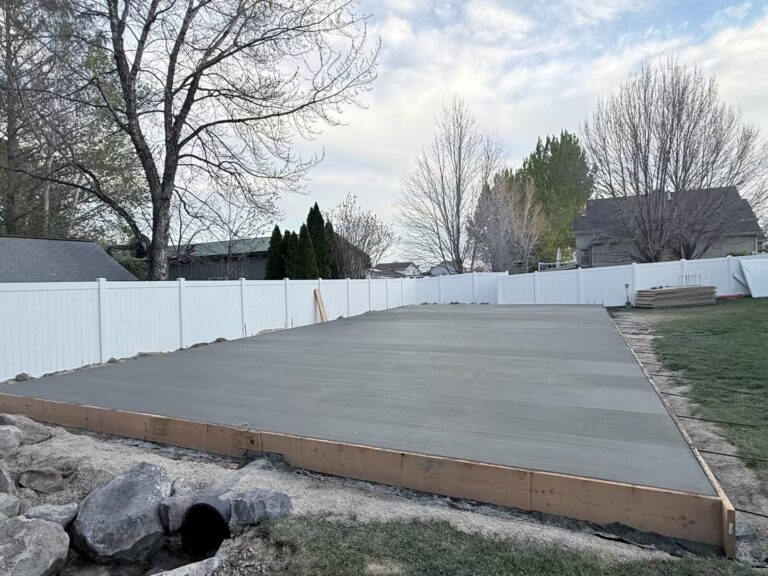
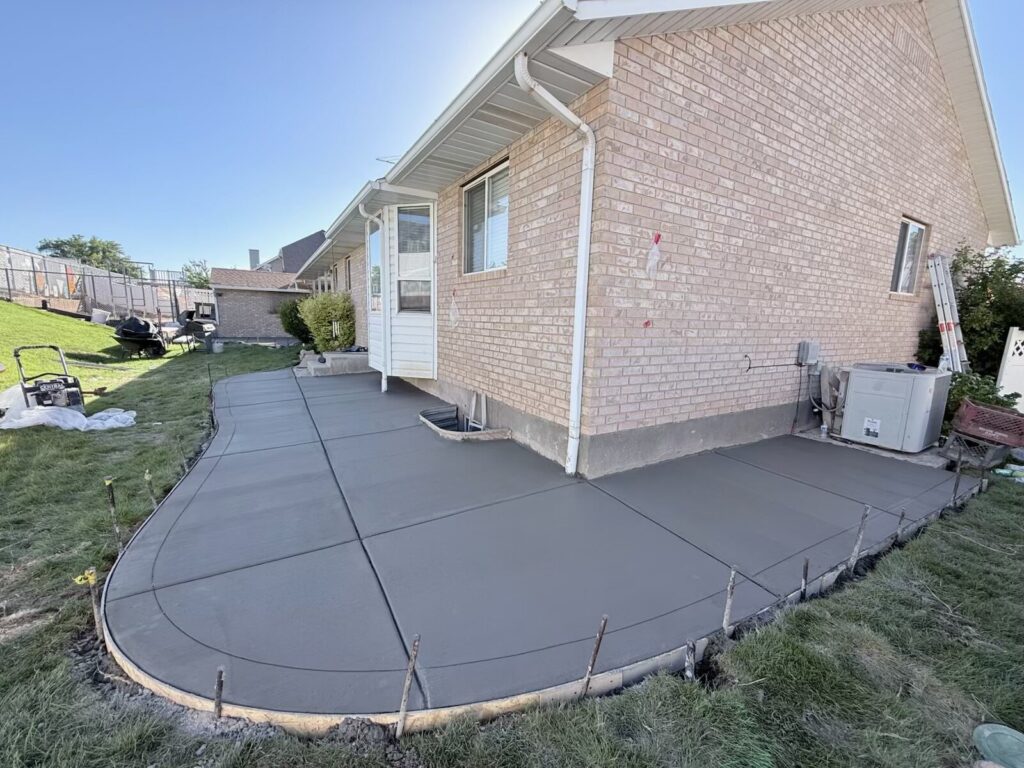
A standard concrete patio uses the same structural mix as any quality slab — air-entrained 4,000 PSI concrete poured over a compacted road-base sub-base, reinforced with rebar or wire mesh, and finished with a broom drag. That broom texture creates a mildly rough surface that provides traction when wet, drains well, and hides minor surface scratches.
The result is a clean, neutral surface that ages gracefully and pairs with almost any landscaping style. “Plain” doesn’t mean boring: a broom-finish patio with crisp forms, good proportions, and well-placed control joints looks intentional and sharp. It’s also the baseline everything else is compared against when it comes to cost and maintenance.
If you’re considering any concrete patio for your Provo or Utah County home, see our full concrete patio service page for what’s included in an installation.
What Is a Stamped Concrete Patio?
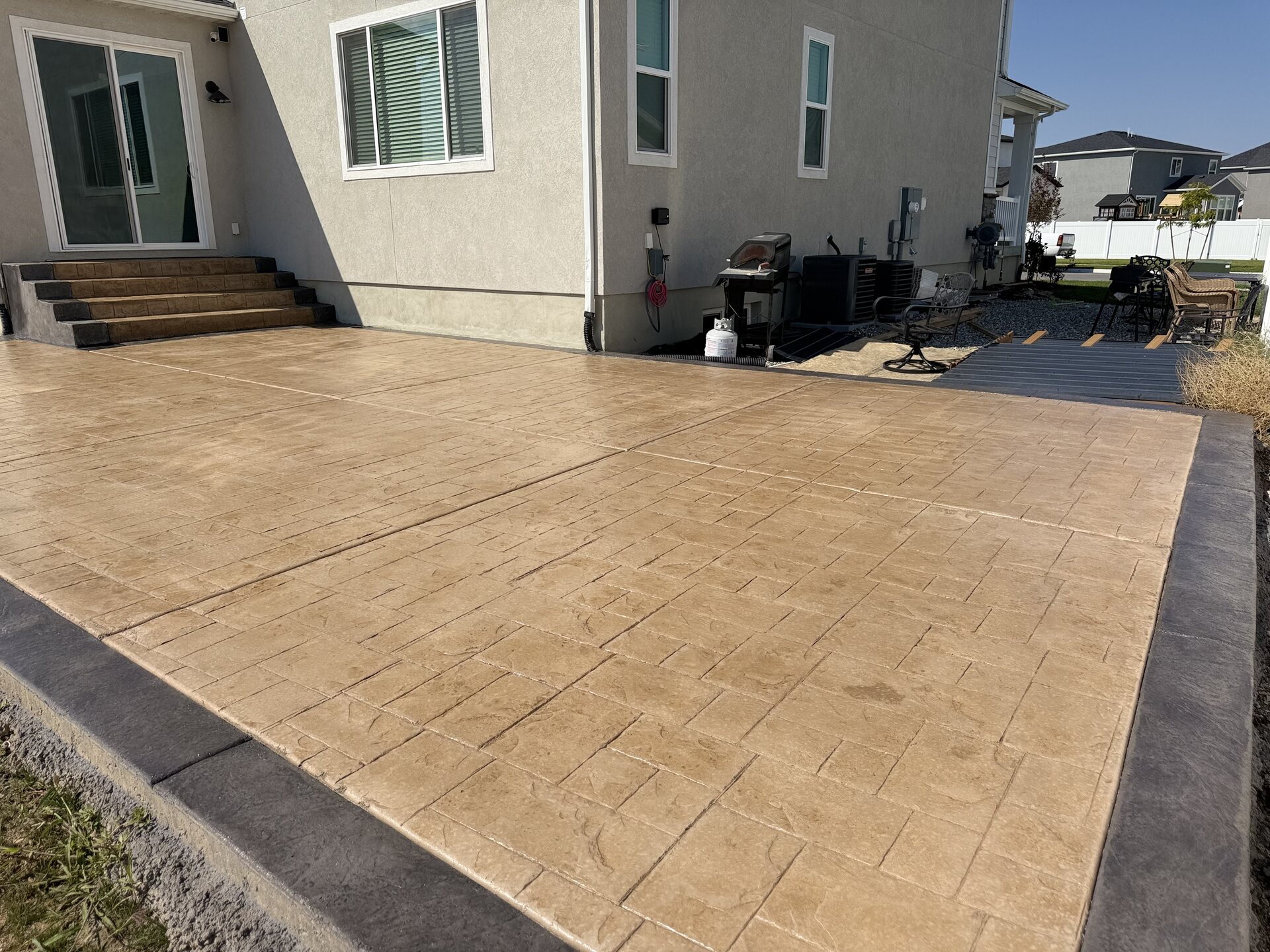
Stamped concrete starts with the same structural slab but adds color (integral pigment mixed into the pour or a color hardener broadcast on top) and texture (rubber stamp mats pressed into the surface while the concrete is still workable). The stamps can replicate the look of natural stone, slate, flagstone, cobblestone, wood planks, brick, or custom geometric patterns.
A release agent — typically a contrasting powder or liquid — is applied before stamping to highlight the pattern and create depth. After curing, a penetrating or film-forming sealer locks in the color and protects the surface. The finished product can be genuinely beautiful, and from a distance it’s difficult to distinguish quality stamped concrete from real stone.
For the full range of decorative options available in Utah County, explore our stamped and decorative concrete page.
Appearance: How Different Do They Actually Look?
This is where the two options diverge most dramatically. A broom-finish patio has a consistent gray-to-off-white tone (concrete color varies naturally with mix and cure conditions) and a uniform brushed texture. It reads as “concrete.” That’s not a disadvantage — plenty of modern and contemporary Utah homes look exactly right with a clean gray slab — but it is what it is.
Stamped concrete gives you control over both color and pattern. Popular choices in Utah include ashlar slate (rectangular stone blocks), Tuscan slate, cobblestone, and random flagstone patterns. Color palettes can range from warm sandstones and terracottas to cool gray-blues that complement Utah’s mountain backdrop. A skilled crew using quality stamps and color can produce a patio that looks surprisingly like natural stone at a fraction of the material cost.
The caveat: stamped concrete looks as good as the crew that installs it. Poorly aligned seams, uneven color, or stamping done at the wrong stage of set can produce results that are visibly artificial and hard to fix. Choose an experienced contractor — ask to see actual project photos, not just manufacturer samples.
Cost Comparison: Stamped vs. Standard Patios in Utah
Here are typical installed price ranges for Utah County homeowners. These are estimates for planning purposes — your actual price depends on size, site prep, access, and finish complexity. Request a free quote for an exact number.
Price ranges are estimates for Utah County projects. Actual cost varies with slab size, thickness, demolition, pattern complexity, and material costs at time of pour. All estimates are free and written.
The gap between a basic broom-finish and an entry-level stamped patio has narrowed as stamping equipment has become more common. On a 300-square-foot patio, you might pay $1,800–$3,900 for broom finish versus $2,700–$9,000 for stamped, depending on the pattern complexity and color system. For many homeowners, the question becomes: does the visual upgrade justify the premium for their specific yard and goals?
Maintenance: Resealing and Long-Term Care
Both patio types benefit from sealing, but stamped concrete requires it in a way that broom-finish does not.
A standard broom-finish patio can go several years between sealings without noticeable harm — the surface is plain and small cracks can be patched without color-matching concerns. We recommend sealing every 2–3 years regardless, because sealer is cheap insurance against Utah freeze-thaw damage and de-icing salt infiltration.
Stamped concrete depends on its sealer to protect the color and sheen. A film-forming acrylic sealer — the most common type used on stamped work — sits on top of the surface and will show wear: scuffing, flaking, whitening (a phenomenon called “blushing”), and tracking footprints if the sealer is applied too thick or in humid conditions. In Utah’s climate, stamped patios typically need a fresh sealer coat every 2–3 years. Skip it, and the color fades and the surface becomes vulnerable to moisture and freeze-thaw scaling.
If resealing sounds like a hassle, it’s manageable — a typical 300-square-foot patio runs $300–$900 per sealing at typical Utah rates, or you can DIY with the right product. The key is staying on schedule. See our concrete sealing service for more detail on what sealing involves and how often it’s needed.
Broom-Finish Maintenance
- Seal every 2–3 years (recommended, not critical)
- Patch cracks without color-matching concerns
- Surface wear adds character rather than looking damaged
- No gloss to maintain or restore
Stamped Concrete Maintenance
- Reseal every 2–3 years (critical for appearance & durability)
- Watch for sealer peeling, whitening, or scuffing
- Color touch-ups possible but require color-matching skill
- Consider penetrating sealers for lower-sheen maintenance options
Durability and Freeze-Thaw Performance in Utah
Utah County sits at roughly 4,500–5,000 feet elevation. Provo, Orem, American Fork, and Lehi all see dozens of freeze-thaw cycles each winter — days that start below freezing and warm above 32°F by afternoon, then refreeze at night. That cycling is hard on any concrete surface and especially hard on porous or sealed surfaces where water can infiltrate and expand.
Both standard and stamped concrete can handle Utah winters when installed correctly:
- Air-entrained 4,000 PSI mix — the microscopic air voids give freezing water room to expand without fracturing the surface. This is non-negotiable for either finish type in Utah.
- Proper sub-base — compacted road base prevents differential settling and frost heave in Utah’s clay-heavy soils.
- Control joints — guide shrinkage cracks to predictable locations so they don’t telegraph through a stamped pattern unexpectedly.
- Avoid de-icing salts — critical for both types, but especially for stamped concrete where salts can strip the sealer and destroy the color. Sand and a shovel are your winter friends; skip the Halite or rock salt entirely, especially the first winter after pouring while the concrete is still curing and moisture is still leaving the slab.
One structural note: the stamps create a texture, not a structural weakness. A properly stamped slab is no thinner or weaker than a broom-finish slab — the pattern is pressed into the top surface only, while the structural thickness and reinforcement remain the same. The durability difference comes from maintenance, not from inherent structural weakness in the stamped surface.
Resale Value: Does Stamped Concrete Add More?
In Utah’s competitive housing market, outdoor living space is a real selling point. Buyers in Provo, Draper, Lehi, and the broader Wasatch Front increasingly treat outdoor patios as an extension of the home’s living area. A well-executed stamped concrete patio can make a home feel more finished and ready to enjoy — and can show well in listing photos in a way a plain gray slab cannot.
That said, the resale calculus is nuanced. A stamped patio in excellent condition with fresh sealer adds appeal. A stamped patio that’s faded, peeling, or cracked can actually be a detractor, because buyers see future maintenance cost. A clean, well-maintained broom-finish patio is nearly always neutral-to-positive at resale.
The honest answer: both options add value when maintained. Stamped has higher upside if well-kept; broom-finish has less downside if not. If you plan to sell within five years and won’t commit to the resealing schedule, a well-proportioned broom-finish patio may serve you better than a stamped one you can’t maintain.
How to Decide: A Simple Framework
After covering all the comparisons, most homeowners land in one of a few buckets. Use this as a starting point, then talk through the specifics with us during your free estimate:
- Choose broom-finish if your primary goal is durability and value per dollar, your style is modern/minimalist, you want minimal ongoing maintenance, or you’re on a tighter budget and plan to add planters, furniture, and landscaping to dress up the space.
- Choose stamped if outdoor aesthetics are a priority, you want the look of natural stone without the cost or maintenance of actual pavers, you’re comfortable committing to resealing every 2–3 years, and you have a skilled contractor you trust to execute the pattern and color correctly.
- Consider a hybrid — broom-finish field with a stamped border, or a colored (stained) slab with broom texture — if you want visual interest without the full stamping premium or maintenance commitment.
- Get a written quote for both before deciding. The price gap on your specific project might make the decision easy. We’ll give you numbers for both options at the same visit.
Ready to see what either option would look like and cost on your specific project? Request a free on-site estimate and we’ll walk your space, talk through pattern and color options, and give you a clear, written number for both finishes.
Stamped vs. Standard Patio: Your Questions Answered
Is stamped concrete slippery when wet?
It can be, especially with a high-gloss film-forming sealer. A skilled contractor applies a non-slip additive (fine sand or aluminum oxide particles) to the sealer coat, which significantly improves traction without dulling the finish. Ask specifically about anti-slip additive before your patio is sealed. Standard broom-finish concrete is naturally slip-resistant because of the brushed texture.
Can stamped concrete be repaired if it cracks?
Yes, but repairs are more complex than on a plain slab. Color-matching the repair to the existing pigment and recreating the stamp pattern is skilled work. Minor cracks can be injected and textured to minimize visibility. Major cracking often points to a sub-base problem, which should be addressed before any surface repair. Always consult a contractor before attempting a DIY repair on a colored or stamped surface.
How long does stamped concrete last in Utah?
With proper installation and regular sealing, a stamped concrete patio can last 25–35 years or more. The concrete itself is as durable as any other slab — 4,000 PSI air-entrained mix on a proper base. The finish (color and pattern) remains excellent as long as the sealer is maintained on schedule. Neglected sealer is the most common reason stamped patios look worn after 10–15 years.
Do I need a permit for a concrete patio in Provo or Utah County?
Most residential patios do not require a building permit in Utah County cities, but rules vary by municipality and project scope. Covered patio structures (pergolas, patio covers) typically do require a permit. We’ll let you know at your estimate if your project triggers any permit requirements for your specific city.
Can I add color to a standard broom-finish patio instead of stamping?
Yes. Integral pigment mixed into the concrete before the pour gives the entire slab a consistent color throughout. Acid staining or water-based staining can be applied after the concrete cures for a variegated, natural look. Either option is less expensive than full stamping and still provides a meaningful visual upgrade over plain gray concrete.
Which type is better for a covered patio or porch?
Both work well under a covered structure. Stamped concrete looks especially elegant in a covered outdoor room because it’s protected from UV and rain, which slows sealer degradation significantly. If your patio will be largely covered, stamped concrete becomes even more cost-effective because resealing intervals extend and the finish stays sharper longer.
Ready to Plan Your Patio? We’ll Give You Quotes for Both Options
Bedrock Concrete Pros serves Provo, Utah County, and the Wasatch Front. Get a free, written estimate with pricing for broom-finish and stamped options side by side — no pressure, no obligation.