Heated Driveways · Utah
Heated Driveways in Utah: Cost and Is It Worth It?
Snowmelt systems eliminate shoveling, ice, and de-icing salt from your driveway—but they’re a significant investment. Here’s what heated driveways actually cost in Utah, how electric and hydronic systems compare, and who they make the most financial sense for on the Wasatch Front.
How Much Does a Heated Driveway Cost in Utah?
The price of a heated driveway depends on whether you’re building new or retrofitting an existing slab, and which heating system you choose. Here are typical installed price ranges for Utah homeowners:
These are estimates for planning purposes only. Your actual cost depends on driveway size, system type, boiler or electrical panel requirements, and labor. Contact us for a free on-site quote.
To put that in perspective: a standard two-car concrete driveway in Utah (roughly 400–600 sq ft) runs $3,200–$9,600 without heat. Add a heating system and the same slab costs $4,800–$16,800, depending on system choice and complexity. That gap is the investment you’re weighing against decades of easier winters.
Electric vs. Hydronic Heated Driveways: Which Is Right for Utah?
Both electric and hydronic systems work by warming the concrete from below, melting snow and ice before it accumulates. They differ in up-front cost, operating cost, and how well they suit different home situations.
Electric Radiant Systems
Electric systems use resistance cables or pre-formed mats embedded in the concrete. They’re cheaper to install, simpler mechanically, and a good fit for smaller driveways or situations where running a boiler and tubing isn’t practical.
- Lower install cost — no boiler, no antifreeze loop
- Simpler retrofit — cables can be saw-cut into existing concrete
- Easier zoning — break the driveway into independent circuits
- Higher operating cost — electricity is more expensive than gas per BTU
- Good for: single-car driveways, walkways, steps
Hydronic (Hot-Water) Systems
Hydronic systems pump heated water through cross-linked polyethylene (PEX) tubing cast into the slab. A boiler—natural gas, propane, or heat-pump-based—heats the water. Larger up-front investment, lower long-term energy bills.
- Higher install cost — boiler, manifold, tubing, antifreeze
- Lower operating cost — gas heat is cheaper per BTU than electric
- Better for large driveways — 600+ sq ft where savings add up
- Longer lifespan — tubing rated 50+ years
- Good for: large driveways, heated garages, whole-property systems
For most Utah homeowners with a standard two-car driveway, the decision often comes down to whether you have (or want) a gas boiler. If you’re already heating a garage or a large home with radiant heat, tying the driveway into that system with hydronic tubing is almost always the better long-term value. For a smaller driveway or a standalone project, electric is simpler and still effective.
The Real Benefits: Why Utah Homeowners Install Heated Driveways
The obvious benefit is not shoveling. But for Utah homeowners—especially those at higher elevations in the Wasatch Front—there are several concrete (pun intended) reasons a snowmelt system pays back beyond convenience.
- No de-icing salt damage — road salt and calcium chloride are the #1 enemy of concrete in Utah. They accelerate freeze-thaw spalling and destroy slab surfaces within a few years. A heated driveway eliminates the need for salt entirely, which can easily extend your concrete’s life by 10–15 years.
- Safety on steep or shaded driveways — north-facing driveways in Provo foothills neighborhoods, or steep approaches in Springville and Mapleton, can be treacherous. Eliminating ice at the surface—not just melting it temporarily with salt—is a meaningful safety upgrade.
- Protects vehicles and your back — ice, rock salt, and snowblowers all take a toll on cars, landscaping, and joints. A heated driveway is also an ergonomic investment for homeowners who shouldn’t be shoveling.
- No snowblower or plow service needed — plow services in Utah County run $50–$150 per visit. At 10–15 visits per winter, that’s $500–$2,250 annually that starts offsetting your system cost.
- Preserved curb appeal — no salt stains, no scraped concrete edges, no tire ruts from snowblower passes. Your driveway looks clean and maintained all winter.
The ROI: When Does a Heated Driveway Pay Off in Utah?
Let’s be direct: a heated driveway is rarely a pure financial win on paper over a 10-year horizon. The math works better the longer you hold the home, the higher the elevation, and the more snow your driveway gets. Here’s how to think about it:
ROI estimates only. Individual results vary based on home elevation, snowfall, utility rates, and driveway size.
The break-even math typically works best for homeowners at higher elevations (Highland, Mapleton, north Provo bench, Draper hillsides), those who pay for snow removal, and those planning to stay in the home 10+ years. For lower-elevation Utah County homes that might see 5–8 snowfalls a year, the convenience argument is real but the financial case is thinner.
One underrated ROI factor: the no-salt benefit. Homeowners who currently use de-icing products heavily are slowly destroying their concrete driveway. Spalling and surface scaling can start showing up within 3–5 years on a slab that gets salted every winter. If you’re about to replace a damaged driveway anyway, pricing in a heating system at new-pour time—when the incremental cost is lower—is worth a hard look.
How Heated Driveway Installation Works
Installing a snowmelt system during a new concrete pour is the most efficient approach. Here’s how we do it.
Sub-Base & Forming
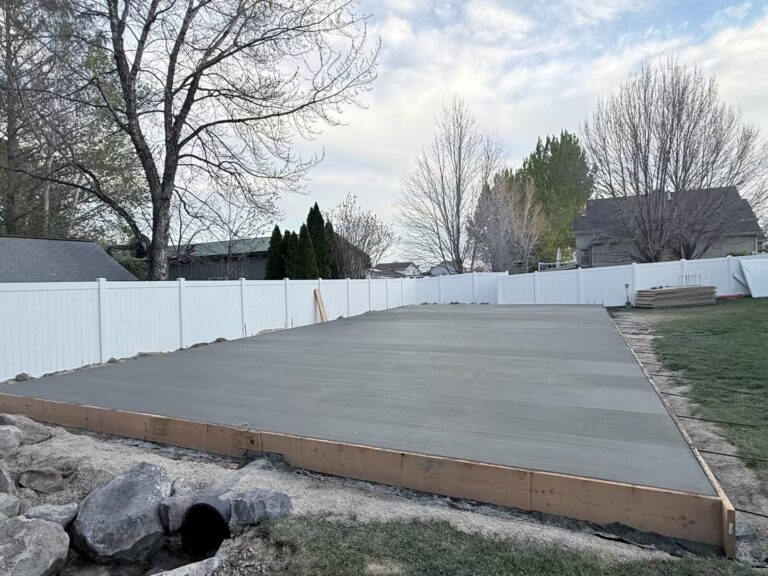
We excavate, compact road base, and form the driveway exactly as we would for a standard pour—the heating system is installed on top of the prepared base.
System Layout & Fastening
Electric cables or hydronic PEX tubing are laid out in a serpentine pattern at the correct spacing (typically 6–9 inches), fastened to rebar or wire mesh reinforcement so they stay positioned during the pour.
Pour, Finish & Control Joints
We pour 4,000 PSI air-entrained concrete, finish the surface, and cut control joints carefully—avoiding the heating elements beneath. Joints are mapped so they don’t compromise the system.
Activation & Testing
Once the concrete has cured (minimum 28 days before first activation is recommended), the system is connected, pressure-tested if hydronic, and commissioned. We walk you through operation and sensors.
Who Should (and Shouldn’t) Get a Heated Driveway in Utah
A heated driveway is not for every Utah homeowner. Here’s a straight-talk breakdown of who typically gets the most value:
Good candidates
- Higher-elevation homes (Provo bench, Highland, Mapleton, Draper hillsides) with 12–30+ inches of annual snowfall
- North-facing or heavily shaded driveways where ice lingers
- Steep driveway grades where ice is a safety hazard
- Homeowners who physically can’t shovel or don’t want to pay for plow service long-term
- Anyone replacing a salt-damaged driveway who doesn’t want the same problem again
- Homes with existing hydronic heat systems (much lower incremental cost to extend)
Think twice if…
- You’re in a lower-elevation Utah County neighborhood with light annual snowfall
- You plan to sell within 5 years and won’t recoup the investment
- Your driveway faces south and already melts quickly with sunlight
- Budget is the primary constraint—a quality standard concrete driveway properly sealed and maintained is an excellent choice
Not sure which camp you’re in? Call us for an honest conversation about your specific driveway situation.
Heated Driveway FAQs
What is the cost per square foot for a heated driveway in Utah?
New heated concrete driveways typically run $12–$28 per square foot installed in Utah, depending on whether you choose an electric or hydronic system and the complexity of the installation. Retrofit installations on existing concrete run $7–$17 per square foot. These are estimates—contact us for a free on-site quote.
Is electric or hydronic better for a Utah driveway?
It depends on your driveway size and existing home systems. Electric radiant is simpler and cheaper to install, making it a good fit for smaller driveways and standalone projects. Hydronic systems cost more up front but have lower annual operating costs—they’re the better value for large driveways (600+ sq ft) or homes that already have a boiler. We’ll walk you through the trade-offs at your free estimate.
How much does it cost to run a heated driveway each winter?
Operating costs in Utah typically run $120–$600 per year depending on system type, driveway size, and how many activation hours your snowfall requires. Electric systems cost more to run; hydronic systems with a gas boiler cost less. Smart sensors that only activate when snow is actually falling can cut operating costs significantly.
Does a heated driveway add home value?
A heated driveway can be a selling point—especially in mountain communities and higher-elevation Wasatch Front neighborhoods where buyers are familiar with the convenience and salt-damage problem. However, it typically does not add dollar-for-dollar value at resale. The primary benefit is personal use and driveway longevity, not a guaranteed return at sale.
Can a heated driveway be added to existing concrete?
Yes, but it’s more complex and expensive than installing during a new pour. Options include saw-cutting channels for electric cables, or tearing out and replacing sections. For most retrofit scenarios, the cost is $7–$17 per square foot. If your existing driveway is already aging or salt-damaged, a full tear-out and replacement with a heating system embedded in the new pour is usually the better approach. See our concrete driveways page for replacement details.
How long before I can use the heated system after pouring?
We recommend waiting the full 28-day cure period before first activating the heating system. Running it too early can cause thermal stress in concrete that hasn’t reached full strength. You can drive on the driveway after about 7 days, but hold off on running the heat until the slab is fully cured.
Ready to Explore a Heated Driveway for Your Utah Home?
If you’re building a new driveway or replacing an old one, now is the right time to evaluate whether a heating system makes sense for your property. Adding heat during a new pour is far more cost-effective than retrofitting later. Bedrock Concrete Pros can walk you through both options, give you a clear cost comparison, and help you decide what’s right for your specific home and snowfall situation on the Wasatch Front.
We serve homeowners across Provo, Orem, Lehi, Draper, Springville, Mapleton, and throughout Utah County and the Wasatch Front. Our heated driveway service page has more details on the systems we install, and our concrete driveways page covers the full-pour process and standard driveway pricing. Have a project in mind? Request a free estimate or call (801) 854-7174—we’re happy to give you a straight answer about whether a heated driveway is the right call for your home.
Get a Free Heated Driveway Quote
Tell us about your driveway project and we’ll give you a clear, written estimate—no pressure, no obligation. We serve Provo, Utah County, and the Wasatch Front.